



Overview of the Department of Physics Sciences
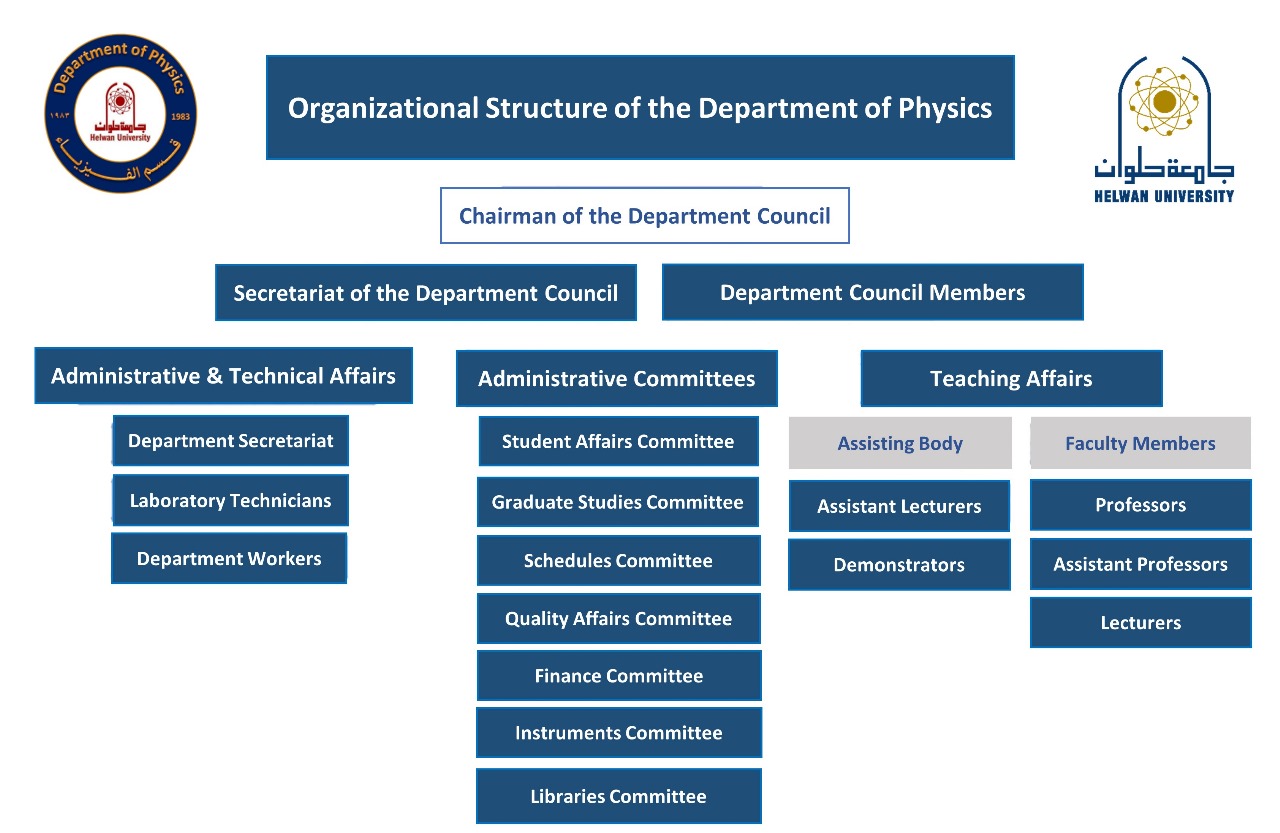
The Physics Department was established as one of three departments at the Faculty of Science, beginning with the college, which was founded in 1980 by a presidential decree issued on September 28, 1980 (and governed by Law No. 49 of 1972 regulating universities). Actual studies began in the department and college in October 1983. Since its inception, the Physics Department has also taught basic science courses in the remaining faculties of Helwan University, such as the Faculties of Engineering, Computer Science, Education, Applied Arts, Fine Arts, Home Economics, Music Education, and others. The Physics Department began with a single educational program: Physics. At the beginning of the third millennium, the college amended its educational regulations to keep pace with the demands of the labor market and scientific and technological progress. The Physics Department's developments in the new regulations include the establishment of four undergraduate programs: physics, medical biophysics, space sciences, and physics and chemistry. These programs also include seven master's and seven doctoral programs in specializations that cover a wide range of labor market requirements, such as nuclear and radiation physics, optical physics, lasers and their applications, solid-state and electron physics, astrophysics, space sciences, medical biophysics, and theoretical physics. The Physics Department includes a distinguished group of qualified professors and scientists from international universities in Europe, the United States, and Japan, as well as a number of teaching assistants, assistant professors, and laboratory technicians.
The Physics Department includes research laboratories serving graduate students and faculty members. These include laboratories for semiconductors, solar cells, magnetic materials, superconducting materials, multifunctional materials, nanomaterials, lasers and their applications, radiation and nuclear physics, high-energy physics, medical biophysics, and nanotechnology. The Physics Department also has a scientific library that provides students with specialized books and practical references. The Physics Department includes a distinguished Space Weather Center, the first in Egypt and the second in the Middle East. The Physics Department is committed to providing students with the academic level necessary to meet the changing demands of the job market and keep pace with the latest scientific advances in physics.